Life science, data science, and mathematical modeling are so much more entertaining with the new AI tools available today. Here is a brief guide to what is out there and how you can use it to improve your science — from searching the literature to writing, analyzing, and visualizing your results.
Software development is undergoing a fundamental shift. Today, artificial intelligence enables people with basic coding knowledge to build complex, production-ready web applications. However, simply asking an AI model to "build a website" often results in messy codebases, broken styles, and endless debugging loops.
To build efficiently, we need structure. We need to feed the AI structured instructions organized under a solid building framework. That is where the BLAST framework comes in. Inspired by Jack Roberts’ viral video, "100 hours of AntiGravity lessons in 47 minutes", this post details how you can use the BLAST methodology to build your own personal website or a business application.
The efficiency of AI tools depends on the context we provide them. In particular, the model should be able to read at least: 1) global instructions (AGENTS.md), 2) custom instructions/skills (skills/ folder), and 3) personalities/agents (agents/ folder). Some publicly available skill repositories and agents are amazing; however, in the AI world, there seems to be a consensus among users that the best results come from carefully crafting these files manually. Therefore, managing these files across different models has become a key aspect of maintaining a truly model-agnostic workflow.
The AI space is moving fast, and it’s quite hard to keep up with all the new vocabulary. A few months ago I started using multiple AI tools simultaneously — Claude Code for coding work, OpenCode in the terminal, Cowork for file tasks, Antigravity for web pages. What I noticed quickly is that the same concepts get different names depending on who built the tool, and people use “model”, “agent”, and “AI” interchangeably in ways that create real confusion when you try to set up a coherent workflow.
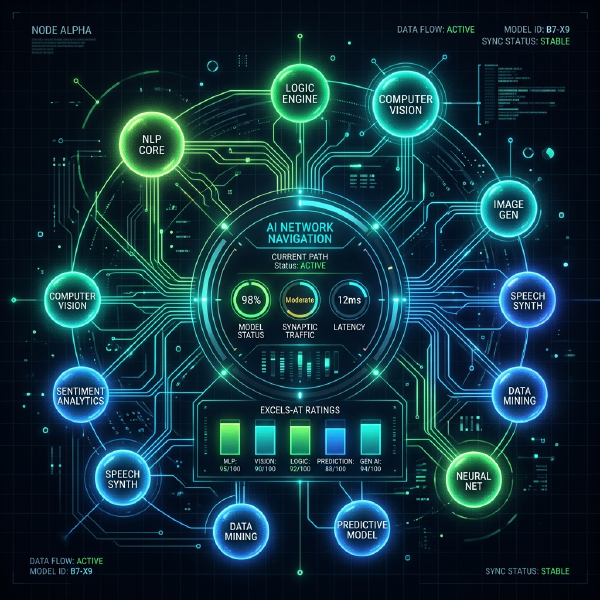
AI models are evolving at a pace that is genuinely hard to keep up with. Every few weeks, a new model tops a benchmark, a new interface ships, and the previous “best option” quietly steps aside. More importantly, different models are now excelling at very different tasks, writing, coding, math, image generation, cost efficiency, which means that relying on a single model is increasingly a limitation, not a workflow.
To navigate this effectively, there are three things worth keeping distinct: the parent company, the model itself, and the interface you use to interact with it. These are three separate things that receive different names and are often conflated, which creates unnecessary confusion. A company like Anthropic builds models like Sonnet and Opus, which you can access through claude.ai, the desktop app, or Claude Code in the terminal. Same logic applies across the board. Getting this picture clear is the first step toward using AI deliberately rather than by habit.
AI can be an excellent tool to help scientists develop ideas, write papers, and refine their output. My impression is that resistance to adoption comes from a real limitation: research requires more than text editing. It requires connecting to the sources of knowledge. Since Anthropic popularized MCP servers, that connection has become practical. MCP (Model Context Protocol) is an open standard that lets AI models communicate directly with external tools and data sources. For scientists, this means your AI assistant can search the literature, retrieve papers, and rank them by citation impact, all within the same conversation. The best source for this is Scite, a paid service that not only counts citations but tells you whether a paper was supported or contradicted by subsequent work. Here I present the best free and low-cost alternatives, what each one is good for, and how to combine them depending on your workflow. The ranking below compares seven available MCP servers across citation quality, coverage, and workflow fit, with notes on what to pair with what. I have tried some of them and find them useful for different purposes.I’d genuinely like to hear what has worked for you.patricio@pperezh.com.